
Eclat by NRJ
New
Blog · Beauty Tips
Fragrance Families Explained: Floral, Woody, Fresh, Oriental
By Eclat Team · 28 September 2026
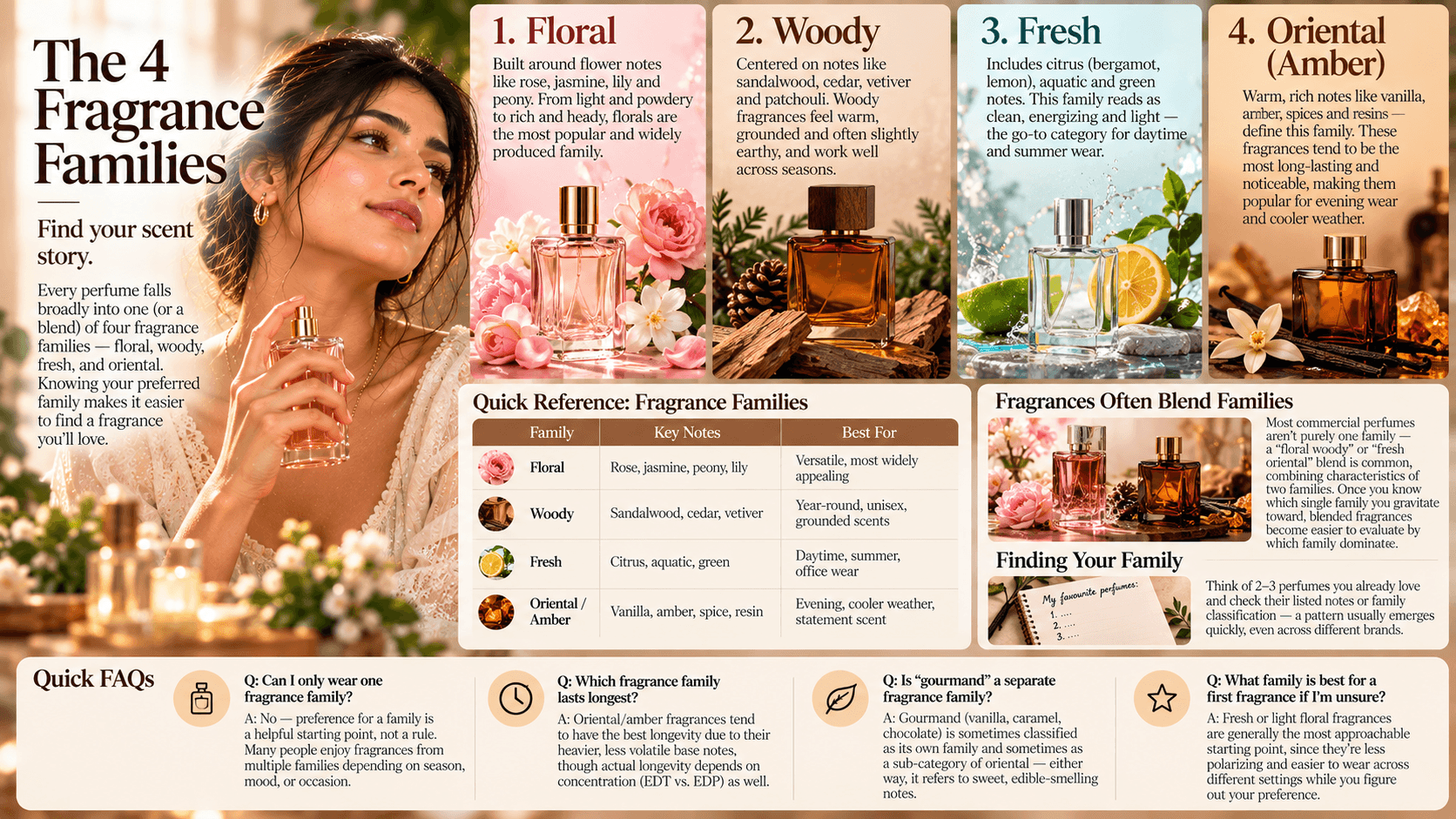
Every perfume falls broadly into one (or a blend) of four fragrance families — floral, woody, fresh, and oriental — based on its dominant character. Knowing your preferred family makes it far easier to predict whether a new perfume will suit you, rather than guessing from the bottle or brand name alone.
Floral
Built around flower notes — rose, jasmine, lily, peony — floral fragrances range from light and powdery to rich and heady. They're the most popular and widely produced family, which means there's significant range from delicate single-note florals to complex floral bouquets.
Woody
Centered on notes like sandalwood, cedar, vetiver, and patchouli, woody fragrances feel warm, grounded, and often slightly earthy. They tend to work well across seasons and are common in fragrances marketed as unisex or gender-neutral.
Fresh
Includes citrus (bergamot, lemon), aquatic/marine, and green notes. This family reads as clean, energizing, and light — the go-to category for daytime and summer wear, since it tends to feel lighter even at higher concentrations.
Oriental (also called Amber)
Warm, rich notes like vanilla, amber, spices, and resins define this family. Oriental fragrances tend to be the most long-lasting and noticeable, making them popular for evening wear and cooler weather, though they can feel heavy in hot, humid climates.
Quick Reference
Family | Key Notes | Best For |
Floral | Rose, jasmine, peony, lily | Versatile, most widely appealing |
Woody | Sandalwood, cedar, vetiver | Year-round, unisex, grounded scents |
Fresh | Citrus, aquatic, green | Daytime, summer, office wear |
Oriental/Amber | Vanilla, amber, spice, resin | Evening, cooler weather, statement scent |
Fragrances Often Blend Families
Most commercial perfumes aren't purely one family — a "floral woody" or "fresh oriental" blend is common, combining characteristics of two families. Once you know which single family you gravitate toward, blended fragrances become easier to evaluate by which family dominates.
Finding Your Family
A simple way to identify your preferred family: think of 2–3 perfumes you already love and check their listed notes or family classification — a pattern usually emerges quickly, even across different brands.
FAQ
Q: Can I only wear one fragrance family?
A: No — preference for a family is a helpful starting point, not a rule. Many people enjoy fragrances from multiple families depending on season, mood, or occasion.
Q: Which fragrance family lasts longest?
A: Oriental/amber fragrances tend to have the best longevity due to their heavier, less volatile base notes, though actual longevity always depends on concentration (EDT vs. EDP) as well.
Q: Is "gourmand" a separate fragrance family?
A: Gourmand (dessert-like notes such as vanilla, caramel, chocolate) is sometimes classified as its own family and sometimes as a sub-category of oriental — either way, it refers to sweet, edible-smelling notes.
Q: What family is best for a first fragrance if I'm unsure of my taste?
A: Fresh or light floral fragrances are generally the most approachable starting point, since they're less polarizing and easier to wear across different settings while you figure out your preference.
Comments
Be the first to comment.